


When this newsletter launched in 2024, an interview with a ceramicist was at the top of my wishlist. Their work may fill each of our days, but the craft is one I always observed as an outsider. In middle school, several close friends of mine took a pottery class together every week while I dissociated my way through whatever sports practice I was enduring that season. In more recent years, my friend Gina has accomplished that elusive dream of honing a hobbyist craft alongside her weekly workload. Enrolled at Brooklyn Clay, she’s steadily built a catalog of pretty and practical work reflecting her progress as a maker. All this is to say, I never once had an opportunity to try my hand at ceramics—until recently.
Lucky as I am, I happen to know a brilliant ceramicist right here in Brooklyn. I paid my friend Aziza Mirzan a visit at her studio in South Williamsburg this spring for an afternoon of the basics. Aziza gave me a meticulous rundown on all the materials, tools, and machines required for various methods of making ceramics. My mind raced trying to retain the names of all the delicate blades, needles, sponges, and even clay types at our disposal in Aziza’s small but mighty space. She even threw some clay on the wheel at the last minute for a quick tutorial, yielding a sinewy but sturdy vessel rendered with enough swiftness to leave me agape.
Perhaps most memorable of all was wedging. After Aziza let me take the slab roller for a few spins, she coached me through the process of kneading the clay with force to resolve any air bubbles and ensure plasticity. The meditative potential of the practice began to emerge as I rammed my clay into the board for minutes on end. I then dampened my hands to reshape my ram’s head into anything that resembled a functional object. After much titivation, I soon completed an approximation of a mug, personalized as much by its awkward form as it was by the signature I etched into its bottom. I of course walked away with a deepened appreciation for the demand of the work, but I also grasped a sense of its rich reward. To reshape the earth by hand into an object of function is nothing short of alchemy.
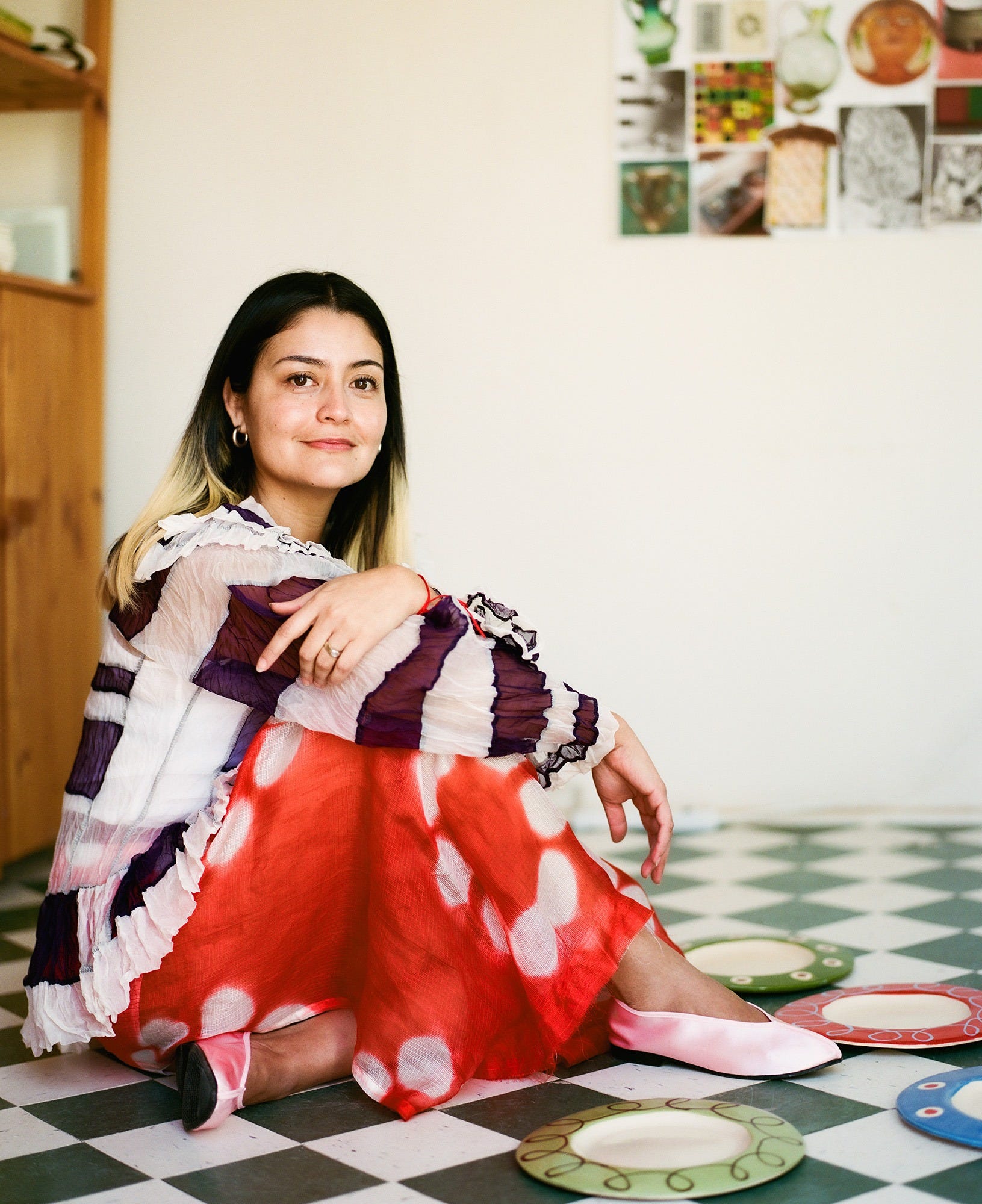
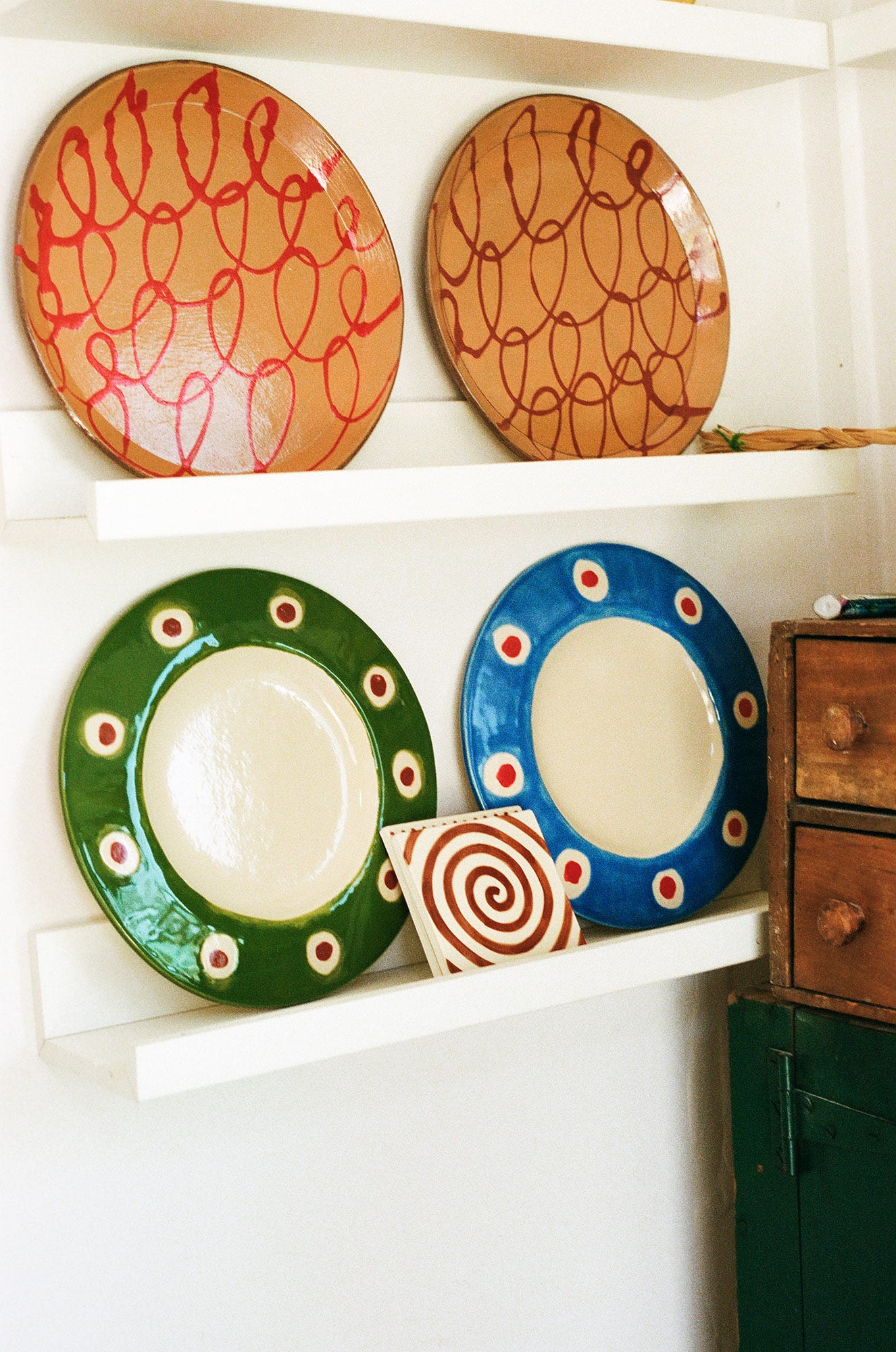
Verónica Ortuño possesses an intimate understanding of the possibilities awaiting us in the clay. Founder and creative director of Casa Verónica, she stands before a vibrant portfolio of distinct objects crafted through vibrations exchanged between her and the clay (literally). Verónica’s Mexican heritage inspires her to enrich her work through longstanding artisan traditions while her history as a punk musician grounds the practice in catharsis, free expression, and authenticity. Oh, and her pieces are cool as hell, too.
Here, Verónica and I discuss becoming both a maker and a business owner, fostering artistic community, and honoring the emotional resonance of her craft.
(Special thanks to the brilliant Tara Kugelman for this one)
Where did you grow up?
I was born in Santa Ana, California. I was there till ’96, and then in sixth grade, we moved to Houston. My dad had passed already at that time, my mom remarried, and she just wanted to start a new life. Texas seemed like the natural next step.
What were your early creative outlets?
I would sew a lot with my grandmother. She made a lot of our outfits growing up, so she taught us how to sew clothes for our Barbie dolls, how to embroider on linen napkins and tablecloths. Aside from that, I joined school choir from kindergarten up until high school. Being Mexican, there’s music all around you all the time. That felt natural to me.
When did ceramics become part of your life?
My family would always go to Tijuana and get pots to cook the beans in. My grandma would make beans in this really tall terracotta pot on the stove. Fast forward to 2017—I was doing an interiors project in Detroit, and I went to the Detroit Institute of Art. I got to see all the ancient ceramic and glass pieces from before the first century. Thinking about just how many lifetimes, how many different hands they had gone through, how much they’ve traveled. It made me think a lot about that time as a kid. These pieces do live for so long. They travel so much, and I can’t believe these shards of pottery and glass are still here. It was a really spiritually moving moment for me. That really shifted something internally for me.
You began practicing in 2019. Where did you learn?
I took a three-week class at Laguna Gloria here in Austin. They just taught basic handbuilding techniques. They offered wheel-throwing, but I was just so terrible at that so I stuck to handbuilding. Then I went to do a few residencies and I worked with the indigenous communities in Oaxaca. I really got to see that process and that’s when it really took off for me.
When did you begin to refine an aesthetic?
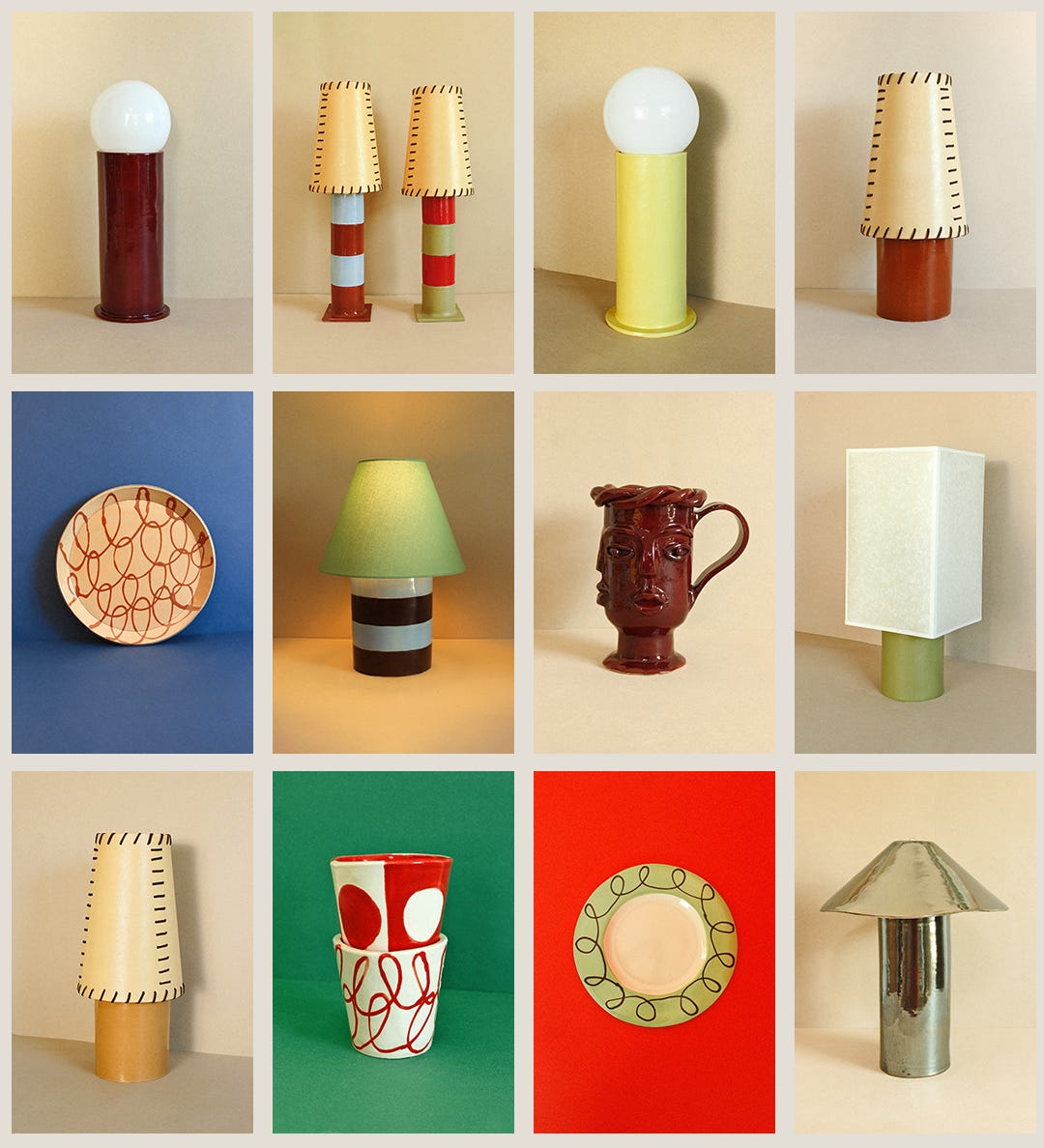
I don’t know that my aesthetic is refined. My aesthetic just evolves with me. It follows the stages of my life and where I am. I feel like my aesthetic is very experimental. Sometimes it could be really fluid and I get into a period where I’m really into sculptures or figurines. Then I get really into more functional pieces or lamps. I was really surprised at how much people gravitate toward the lamps. I didn’t think of myself as being someone who would design lamps so much, but they’re really fun to make.
How has your relationship to material evolved?
I would like to keep exploring the wheel at some point. Right now, I commune so closely with handbuilding. There’s a lot of meditation, there’s a lot of grounding in my practice. There is a spiritual connection there. Actually, the very first time that I touched clay while I was doing the classes at Laguna Gloria, it vibrated. My whole body vibrated. It had this power to it that kind of scared me. There’s a very deep connection with earth that I didn’t even notice was there before.
Did you ever experience this spiritual resonance while making music?
At its core, the ethos of punk is just creative freedom and creative expression. I was 17 when I started playing punk music, and that just blew my mind wide open at the possibilities of what you can do not only in music but in your everyday life. That was foundational. It gave me a lot of confidence to experiment with so many different influences. We live in a system where you need to have one thing that you’re good at, or you need to be perfect at this one thing. Music really just decimated that idea for me. Just being in that space with different artists and friends, it really moves you.
Community clearly matters a lot to you. Is that why you launched your collective, Las Cruxes?
I was fortunate enough to tour with the bands I was in. We got to do some national tours and international tours. We were playing a lot of DIY spaces and galleries. Coming off of those tours, I would come back home to Austin and we would play house parties and clubs. There was a big need in Austin for a cultural hub, like a DIY all-ages space that was open to the community. I really wanted to support my creative peers that I had met along the way, whether they were doing art, whether they were doing a fashion collection. I had this idea that I can create a space where I am having these shows, where there are zine releases, retail space, gallery space, workshops.
You were very ahead of that trend.
They’re everywhere now, right? Now, you see a lot of concept stores and experiential spaces. In 2009, that was far less common. It was needed in Austin and I felt like I should do it.
What were some lessons learned at the helm?
I was so naive going into it. I was mid-20s, and I just didn’t have the financial literacy to open up a business. I had gotten a small $3,000 loan from a friend in the punk community, and then I maybe had $300 that I used to do the buildout. It was all just learning as I went, but that was probably one of the biggest challenges. Just be intentional in what you’re doing and see the long game of it because it’s a lot of work. I do think that knowing what you stand for is also very important. It was just to have a space with a lot of soul and being authentic to who I was. While it wasn’t a moneymaking endeavor, it really spiritually filled me. It was a big labor of love.
How did you get from your initial classes in 2019 to the launch of Casa Verónica?
Through Las Cruxes, I was already into interior design and architecture, and I had gotten this opportunity from an entrepreneur in Detroit who had a music venue. He wanted me to do a few spaces for him. I didn’t go to school for interior design or architecture, but he had visited Las Cruxes, so I went and did those projects. Then lockdown happened. I had just taken a class through the ceramics portion. I was like, “Well, crap. How am I going to subsidize income here? I need to figure something out because I can’t travel to do my interior design work. I no longer have the brick and mortar.” I thought, “You know what? I’m home. I should just build a little shed and just create some pieces and then try to sell my pieces to clients.” So I did.
What was the reception like?
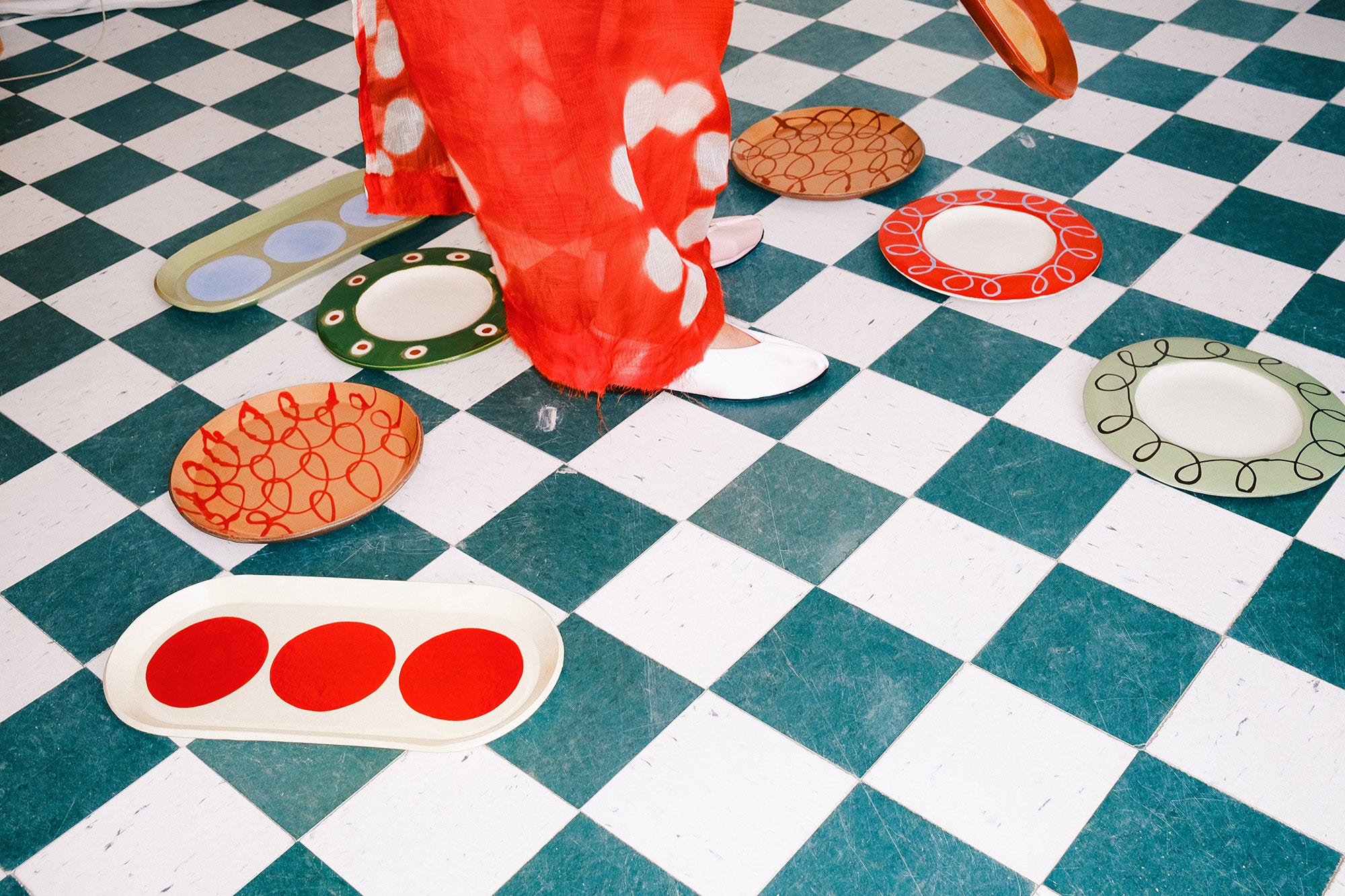
I launched the first collection and everything sold out online. It’s far less stressful than doing interior design. Less liability. It just felt like a clear sign to pivot. I really listened to the signs. I was doing interior design and ceramics for a year, and ceramics just filled me up so much more. I needed to simplify because I’d also just gotten pregnant. It was like having two babies.
How did you want to distinguish yourself as an artisan?
I was just trying to be creative for myself because when I had Las Cruxes, I was supporting a lot of other people and I was kind of losing my creative voice. I felt detached from myself, like my own spirit was diminishing. When I talk about the clay vibrating, I’m like, “This is something that I do need to tap into. Maybe this is going to help me find myself.” I was finding myself again so that I can make things for others.
Does it ever actually feel like work?
Yeah, you do have to be present. It is spiritual, it is a form of therapy for me. You have a lot of time with your thoughts. You’re by yourself, whether you’re listening to music or not, and it really helps me clarify my thoughts, my ideas, my voice, my message.
Are there any ceramicists in particular that you admire?
Betty Woodman. She really changed what’s possible in ceramics and just the scope and scale of what you can do with clay. One of the indigenous families that I did go visit in Oaxaca is José García Antonio. He got glaucoma in his 50s and became blind. He was a potter before then, but after he got glaucoma, he started speaking through his hands. It’s such a beautiful way to translate your work. Anytime I go to Oaxaca, I go sit and talk with them and see their process. The entire family helps out with making pieces.
Are you still making stuff in the shed or do you have a new space?
I’m really trying to get out of that 100-square-foot space. When I first started, I was just trying to stay within budget. I do keep it simple and I only have what I absolutely need and use, but I’m trying to save funds right now so that I can make a bigger space. My dream would be to have a two-story space where operations are up top and then all production’s downstairs.
What are the essentials in there with you?
Just the shelf so that I can have all my bisqueware. Everything is made in small batches, so there’s a section for those pieces and then just works in progress. I may have a few little inspirational pieces that I’m into. If I’m into Romanian glazed bowls, I’ll have a little shelf that has that so I can reference it, but it’s pretty small. I have one table where I do all my handbuilding. I have another table where I have my slab roller, and then I have my tiny hobby kiln in the corner. Somehow I’m able to fit all this stuff.
Your catalog is so colorful and eclectic. What are the throughlines across your work?
Presence is a big one. Having respect for craft and, in turn, having respect for time. I really try to communicate how important my family is—respect for my ancestors, respect for land. While on the surface, pieces may just seem like pretty objects on a shelf, there’s a lot of depth there and there’s a lot of care.
How would you advise other artisans struggling to find their voice?
A big one for me was allowing myself to fail. You should be good at what you do, but I think fear keeps us from experimenting or trying new things. It’s actually okay to fail because when you fail, there’s a lesson learned. If you give yourself grace to fail, you just learn so much. I really do hope that I serve even a small example that following your dreams and experimenting is possible. It’s not always easy, but it’s possible.
What’s next?
I’m a Sagittarius, so I’m always thinking in the macro. This year I’m really trying to ground and simplify and really appreciate the micro. I’m trying to really live for today, finding a lot of presence and a lot of simplicity, but also really harnessing that weird, freaky energy from when I was younger. I’m shifting away from the more expressive pieces to more functional pieces right now, and I kind of want to get back to that freakiness. The weird stuff that maybe not everybody understands. I want to harness that energy a little bit more.
This interview has been edited for length and clarity.